
The FDA Reforms
It is not every day that I compliment this administration, but mark your calendars, today is such a day. I visited the FDA website and I found it inspiring. I was greeted by a list of their accomplishments featuring 40 bullet points, separated in four categories: Food, Drugs, Public Trust and Modernizing the Agency, and a lot of it makes sense. The full list can be seen here.
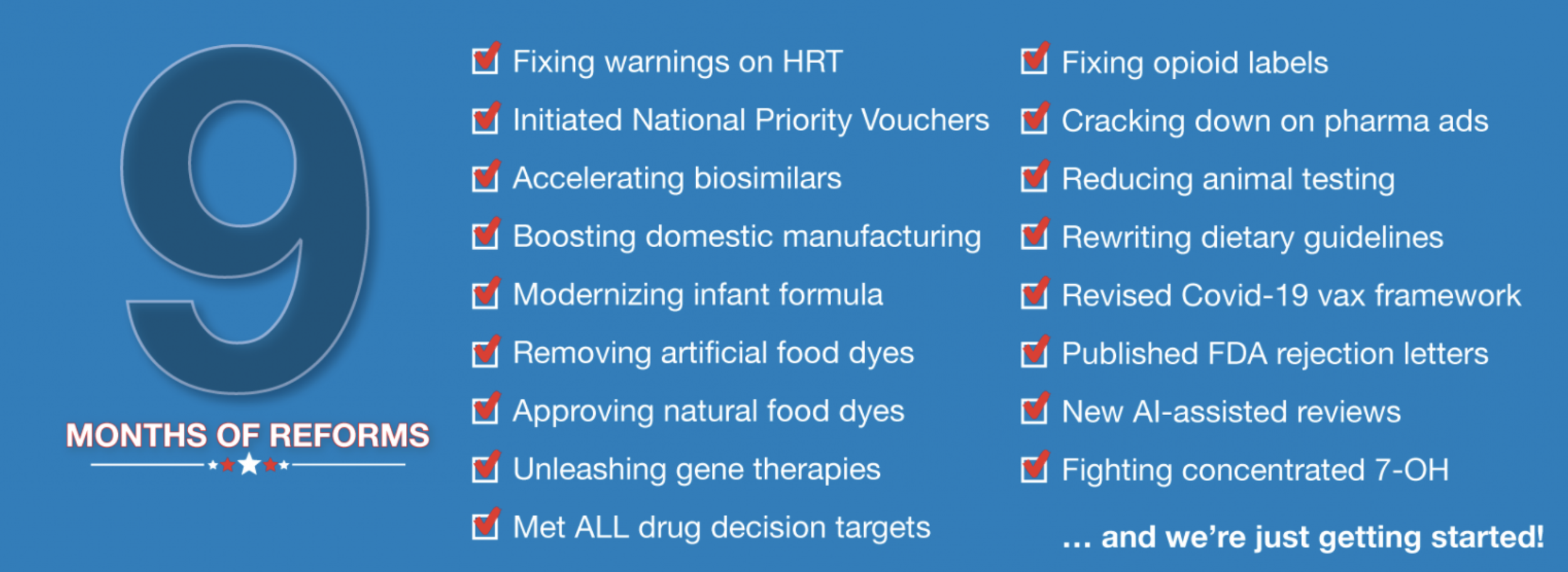
Reform summary at the FDA
I selected a few points that are the most pertinent for the biopharma industry to discuss:
Initiated National Priority Vouchers
The idea is to prioritize products with significant potential to address a major national priority, defined as either 1) meeting a large unmet medical need, 2) reducing downstream health care utilization, 3) addressing a public health crisis, 4) boosting domestic manufacturing, or 5) increasing medication affordability. Those programs will get extra support from the FDA throughout development and are promised an accelerated review, with a response within 1-2 months after filing.
There seem to some overlap with existing prioritization approaches such as Fast Track, Breakthrough Therapy, Accelerated Approval and Priority Review, but if that brings more medicines to market quicker, I am all for it. I also like the idea of prioritizing medicines that will be manufactured un the US, as it could create more jobs in pharma.
Cut Red Tape to Accelerate Biosimilars
The FDA's new guidance seeks to remove the requirement for biosimilars developers to conduct comparative human clinical studies, allowing them to rely instead on analytical testing to demonstrate product similarity.
Furthermore, switching studies, where sponsors alternate between originator and biosimilar (to claim interchangeability) will not be generally recommended. This is could significantly lower the price of biosimilars.
Stopping Unnecessary Animal Testing
The agency wants to reduce or replace animal testing requirements with a range of approaches, including AI-based computational models, cell lines and organoid toxicity testing. This means using lab-grown human “organoids” and organ-on-a-chip to test drug safety. These experiments can reveal toxic effects that could easily go undetected in animals, providing a more direct window into human responses.
The roadmap also encourages sponsors to leverage computer modeling and artificial intelligence to predict a drug’s behavior.
Boosting Domestic Pharmaceutical Manufacturing
The FDA PreCheck program was developed to promote domestic production of critical medicines by streamlining the review of those that will be produced in the USA. This program should improve regulatory predictability and shorten time-to-market.
The FDA will support the sponsors with more frequent communications at critical development stages and help them streamline the development and license application process through pre-application meetings and early feedback. This should have a positive impact in job creation in the pharma industry.
Unleashing Cutting-Edge Gene Therapies
FDA has leveraged its growing experience with Cell and Gene Therapy (CGT) products to implement regulatory flexibilities that accommodate the unique characteristics of these innovative therapies while maintaining rigorous quality standards.
This approach allows regulatory flexibility during clinical development, including relaxed compliance with full GMP requirements prior to late-phase trials, while encouraging ongoing engagement with reviewers as CGT manufacturing continue to rapidly evolve.
Cracking Down on Misleading Pharma Ads
This initiative will enforce a format for cable TV and online ads that will be more balanced and clearly highlights the downsides of the medications as well as the benefits. This will encourage companies to spend less on marketing and create more affordability. Coming from a different country, I must say that the drug commercials are ridiculous here. It plays into the anxiety of vulnerable segments of the population and encourages widespread drug overconsumption. This will not completely stop direct-to-consumer advertising, but any step in that direction is welcome.
Launched Internal AI Tool to Help FDA Employees Work More Efficiently
The tool is called Elsa and lives on a secure cloud-based environment engineered for safety and privacy. It is currently in use to assist reading, writing and summarizing documents to enable faster comparisons. The agency plans to integrate more AI in different processes to further support the FDA’s mission.
They claim to have successfully completed the first AI-assisted scientific review pilot in May 2025 albeit sparce details have been shared. The generative AI tool allow FDA scientists and subject-matter experts to spend less time on tedious, repetitive tasks that often slow down the review process. Everybody uses AI, so it makes sense for the FDA regulators to use it too. It is an interesting to follow as the sponsors and regulator increase their reliance on AI for regulatory submissions and approvals.
What Smart Pharma Companies Should do in 2026
Design programs for what FDA is becoming, not the one you are used to. FDA is explicitly signaling trust in analytics, AI, and human-relevant models over default animal studies and redundant clinical trials. Companies that re-architect development around this reality will move faster and cheaper.
Align portfolios with national priorities Priority vouchers and domestic manufacturing incentives make it clear: regulatory speed is now tied to unmet need, affordability, public health impact, and U.S. manufacturing resilience. Strategic alignment is becoming as important as scientific merit.
Treat CMC as a strategic weapon. FDA’s flexibility for cell and gene therapies lowers early barriers but raises the bar later. The winners will be companies that invest early in process understanding, comparability, and manufacturing agility - long before regulators are forced to ask.
CQA Assessment Using ChatGPT
Recently I had the chance to play with ChatGPT to perform CQA risk assessment. It is something I attempted to do a few months ago when I was at a company. We could only use the most basic version of Copilot and the results were not entirely satisfactory. This time I used ChatGPT+ and the sequence for trastuzumab as an example. The results are scarily good. Notice it finds that W35 is not part of the CDR according to Kabat notation, but knows that it is adjacent to it and therefore oxidation of that residue could still disrupt binding.
Note that I did not ask to provide the literature references to this example, but one can easily add this to the prompt and ChatGPT will oblige. I tried several other modifications and was frustratingly surprised by the answers. Finally, I am not claiming that ChatGPT is better than Copilot for that type of work, just highlighting how fast the field has progressed in just a few months.
Prompt:
This monoclonal antibody (IgG1) is formed of 2 identical light chains and two identical heavy chains as follows:
>Anti-HER2 Light chain (1 and 2)
DIQMTQSPSSLSASVGDRVTITCRASQDVNTAVAWYQQKPGKAPKLLIYSASFLYSGVPS
RFSGSRSGTDFTLTISSLQPEDFATYYCQQHYTTPPTFGQGTKVEIKRTVAAPSVFIFPP
SDEQLKSGTASVVCLLNNFYPREAKVQWKVDNALQSGNSQESVTEQDSKDSTYSLSSTLT
LSKADYEKHKVYACEVTHQGLSSPVTKSFNRGEC

>Anti-HER2 Heavy chain (1 and 2)
EVQLVESGGGLVQPGGSLRLSCAASGFNIKDTYIHWVRQAPGKGLEWVARIYPTNGYTRY
ADSVKGRFTISADTSKNTAYLQMNSLRAEDTAVYYCSRWGGDGFYAMDYWGQGTLVTVSS
ASTKGPSVFPLAPSSKSTSGGTAALGCLVKDYFPEPVTVSWNSGALTSGVHTFPAVLQSS
GLYSLSSVVTVPSSSLGTQTYICNVNHKPSNTKVDKKVEPKSCDKTHTCPPCPAPELLGG
PSVFLFPPKPKDTLMISRTPEVTCVVVDVSHEDPEVKFNWYVDGVEVHNAKTKPREEQYN
STYRVVSVLTVLHQDWLNGKEYKCKVSNKALPAPIEKTISKAKGQPREPQVYTLPPSREE
MTKNQVSLTCLVKGFYPSDIAVEWESNGQPENNYKTTPPVLDSDGSFFLYSKLTVDKSRW
QQGNVFSCSVMHEALHNHYTQKSLSLSPGK
Summarize the risks of W35 oxidation with respect to the 4 following risk categories: biological activity, PK/PD, immunogenicity and safety.
Short answer:
For this IgG1, isolated oxidation of heavy-chain W35 (Kabat, in VH framework 2, “DTYIHWV…”) is generally a low-to-moderate risk liability. Main concern is local Fab destabilization and possible impact on antigen affinity; Fc-mediated PK and classic safety signals are much less directly affected.
Long answer:
1. Biological activity (target binding, effector function)
Location / role
W35 is in the VH framework 2, adjacent to CDR-H1/2, not in Fc.
It contributes to the hydrophobic core that positions the CDR loops and the VH–VL interface rather than directly contacting HER2.
Effect of oxidation
Tryptophan oxidation → hydroxy-Trp, N-formylkynurenine, kynurenine:
Increases polarity in a mostly hydrophobic environment.
Can slightly destabilize the VH framework and alter CDR geometry.
At low levels (a few percent of molecules oxidized at W35):
Expected effect on HER2 binding affinity is typically small.
ADCC/CDC are largely unchanged if antigen binding and Fc remain intact.
At high levels or if oxidation correlates with partial unfolding:
Could reduce affinity and cell-based potency by mis-positioning CDR-H1/H2 or VH–VL.
Risk assessment for biological activity
Intrinsic risk: Low to moderate.
More likely to produce a gradual potency drift than a binary loss of function.
Risk is best quantified by forced-oxidation + binding / cell-based potency comparison and setting a control limit on oxidized variants if needed.
2. PK/PD
Direct mechanisms
W35 is in the Fab variable domain, not in CH2/CH3 where:
FcRn binding sites reside.
Classical Fc oxidation hot spots (e.g., M252/M428, W313) live.
Direct effects on FcRn-mediated recycling, nonspecific Fc receptor interactions, or charge-based clearance are expected to be minimal.
Indirect mechanisms
If W35 oxidation significantly destabilizes the Fab, possible consequences:
Slightly increased fragmentation or aggregation.
Enhanced clearance of aggregates or partially unfolded species.
At realistic in-product levels (e.g., ≤5–10% oxidized at that site), these effects on systemic PK are usually smalland may be within normal batch-to-batch variability.
Risk assessment for PK/PD
Direct PK risk: Low.
Indirect PK/PD risk via instability/aggregation: Low to at most moderate, contingent on empirical data.
Focus PK risk control more on Fc and high-level aggregation than on this single Fab Trp site.
3. Immunogenicity
Potential immunogenic mechanisms
Neo-epitope formation
Oxidized Trp can slightly change local conformation and side-chain chemistry.
The region is in VH framework 2, partly solvent-exposed.
This can, in principle, alter MHC-II peptide repertoire and T-cell recognition.
However, clinical evidence that single-site Trp oxidation in Fab alone drives ADA is limited.
Aggregation-driven immunogenicity
If W35 oxidation destabilizes VH and increases:
Reversible or irreversible aggregates
Subvisible particles
These species are more relevant immunogenicity drivers than the chemical modification itself.
Risk assessment for immunogenicity
Intrinsic chemical neo-epitope risk at W35: Theoretical but low at typical levels.
Aggregation-mediated immunogenicity:
Depends on whether W35 oxidation correlates with increased aggregates under real storage conditions.
Usually managed by controlling total aggregates and oxidized variants.
Overall: Low immunogenicity risk, provided:
W35 oxidation is kept in a controlled range.
Aggregates and subvisible particles remain within standard limits.
Clinical ADA monitoring does not show a correlation with high-oxidation lots.
4. Safety (including off-target effects)
Direct safety concerns
W35 is not in Fc; no direct link to:
Complement overactivation.
FcγR hyper-engagement.
Oxidation at this site is unlikely to introduce a strong new off-target receptor interaction.
Indirect safety concerns
Same mechanisms as immunogenicity:
More aggregates or fragments → potential for infusion reactions or ADA-mediated effects.
Loss of binding specificity (if Fab is destabilized) could, in extreme cases, slightly increase nonspecific binding, but this typically appears only under harsh stress and very high oxidation.
Risk assessment for safety
Direct safety risk: Very low.
Indirect safety risk:
Tied to aggregation and immunogenicity.
Expected to be low if product-quality attributes (oxidation levels, aggregates, particles) meet standard biologics limits and no unusual clinical signals are seen.
Practical takeaways
W35 oxidation is a secondary Fab liability, not a primary one like Fc Met oxidation.
Key control strategy:
Characterize W35 oxidation in forced-degradation and long-term stability.
Correlate with:
HER2 binding / cell-based potency.
Aggregate and fragment levels.
Any ADA or safety signals, if clinical data exist.
If no strong correlations emerge, W35 oxidation can typically be treated as a monitored but not critical quality attribute with relatively broad acceptance limits compared with Fc oxidation hot spots.
First Post
It all begins with an idea.
I am a consultant now. This is something I knew I wanted to try at some point in my career, so here it is. I am consulting on topics related to analytical development of biologics and I intend to post reflections on our industry, as well as practical tips and strategies to shorten development timelines and use less resources.
I wanted to have a central repository for my work-related writings. Some of it will probably end up being cross-posted to other places, but I wanted to have this source repository for myself. Expect topics about analytical strategy, CMC, outsourcing, consulting and AI to be published once a month.
I am particularly interested in exploring how AI and data science can make certain aspects of our work irrelevant or whole functions redundant.