
FDA Wants a Second Set of Eyes on Your First-in-Human CMC Package
A good part of my consulting work over the past year has been reviewing CMC modules for first-in-human INDs, usually a few weeks before submission, when the options for fixing anything are limited. So I read FDA's Expedited IND Pilot announcement with a lot of interest. The agency is essentially formalizing the review I often get asked to do, and moving it earlier.
The Expedited IND Pilot
On September 15, FDA opened applications for the Expedited IND Pilot, part of HHS Operation TrialBlazer. Sponsors apply as a pair with a "qualified research institution" (QRI), which can be an academic medical center, a health network, a CRO, or a regulatory advisory firm. The QRI provides nonclinical, clinical, and CMC input, and FDA then reviews discrete components of the IND on a rolling basis during the pre-IND phase rather than waiting for the full package. The 30-day clock only starts when the final IND goes in.
A few details are worth noting. The cohort is small, 8 to 10 sponsor-QRI pairs. Applications close October 30, and selections are announced December 18. FDA also describes the QRI as "an accountable scientific partner whose endorsement of the submissions is a meaningful checkpoint," and says the pilot may inform a future accreditation model for QRIs.
For the CMC piece specifically, FDA expects the QRI to be able to "assess whether a sponsor's manufacturing and controls approach is appropriate for the stage of development and flag issues that complicate FDA review." That sentence is a pretty good job description for a phase 1 CMC reviewer.
What a second set of eyes usually finds
Whether or not you apply, it is useful to ask what a QRI would flag in your package. From the phase 1 CMC sections I have reviewed, the same few issues come up again and again.
Specifications that were copied, not justified. A platform mAb specification gets dropped onto a bispecific or a fusion protein without asking which attributes actually matter for this molecule. The limits look reasonable, but there is no link between them and the characterization data or the tox lot.
A tox lot that is not clearly representative. The comparison between the GLP tox material and the clinical material is often thin, a side-by-side table of release results with no discussion of process differences or the attributes most likely to shift. This is the question reviewers tend to ask first, and it is the hardest to answer late.
A potency assay that is not ready. For complex modalities, the cell-based assay is frequently still being developed when the IND is being written. A phase-appropriate binding assay plus a clear plan and timeline for the functional assay is usually fine. Saying nothing is not.
Characterization that stops at release testing. Phase 1 does not require a full characterization package, but intact mass, peptide mapping, and a basic look at charge and size variants on the clinical lot go a long way. For ADCs and bispecifics, this is where you show that you understand the product-related impurities specific to your format.
Stability that does not support the clinical plan. Limited real-time data with no supportive stress or accelerated data, and no clear statement of how shelf life will be extended during the trial.
Is the pilot worth applying to?
For a small sponsor with a novel molecule and a first-in-human trial planned in the US, I think it is worth a serious look. The rolling review is the real value. Getting FDA feedback on the CMC module before the 30-day clock starts lowers the risk of a hold on something fixable, and the pilot application itself forces you to describe where your CMC program stands, which is a useful exercise on its own.
That said, it is a pilot with 8 to 10 slots, and FDA states that participation does not change the standards for a safe-to-proceed decision. The sponsor also remains fully responsible for the content. A QRI does not make a weak package strong. It makes the weaknesses visible earlier, which is only useful if there is time to act on them.
Practical takeaways
1. Do the QRI review yourself, now. Whether or not you apply to the program, have someone outside the program read the CMC module against the issues above before you submit. That is the direction the FDA is moving.
2. If you apply, choose a QRI with real CMC depth for your modality. FDA explicitly allows QRIs to bring in external SMEs for gaps. A strong clinical partner with a generalist CMC reviewer will not help much on an ADC or a cell therapy.
If you are preparing a first-in-human IND and want a CMC read before FDA sees it, I am happy to talk.

It has been a year!
One year has passed since I started Letarte Scientific Consulting (LSC). I am very grateful to my network that allowed me to achieve what I wanted to do for a while.
I want to say thank you specifically to:
• All my clients; I worked with 12 companies over the last year.
• The mentors who inspired and encouraged me.
• The former employers who prepared me and helped me make this decision.
• The random connections at conferences and on the volleyball court.
• The friends and former coworkers who hired me.
• The larger consulting firms that trust me to be their large molecules analytical consultant.
• And to the other consultants that I have worked with and form whom I have learned from.
It is really hard to believe it has been 12 months. It was all a blast. I have seen so many projects, made new connections and learned a so much by being exposed to different modalities, solving different problems and learning to adapt to different situations.
Being a consultant has pros and cons compared to woking at a large pharma. On the benefits, it is nice to have the flexibility of working from home most of the time. I can organize my schedule to attend my kids sports games and drive them to practice, or go for an afternoon driving range session, a morning yoga class. The work is also more focused; more science, less fluff. No performance reviews, resource forecasting, all hands meetings, etc.
Another benefit, if you like good food and know your way around the kitchen, you can make yourself a decent lunch. Or put a roast in the oven in between meetings to have a nice dinner with the family later. Coffee is pretty good at home too.
Consulting and working from home also has downsides. No health care subsidies, bonus, 401k, stocks, sick days or paid vacations. You need to figure it out yourself. But with a decent hourly rate and generous tax deductions, it is possible to make it work. Being the home-based parent, you become the default person for kids dentist, doctor’s appointments etc. I was not really prepared for that.
The part about more science and less fluff is a double-edged sword too. Since most of the work is remote, I do miss the casual discussions at the cafeteria, the 1:1 where you really connect and the happy hours after work. Having coworkers also sets a certain standard of discipline that it is easy to fall short of when it is just you and your dog all day. I have found that going for drinks or coffee with friends, working from a cafe, library or coworking space helps with interacting with human adults.
Very grateful for year 1 and looking forward for year 2. Please stay in touch and connect.
Simon
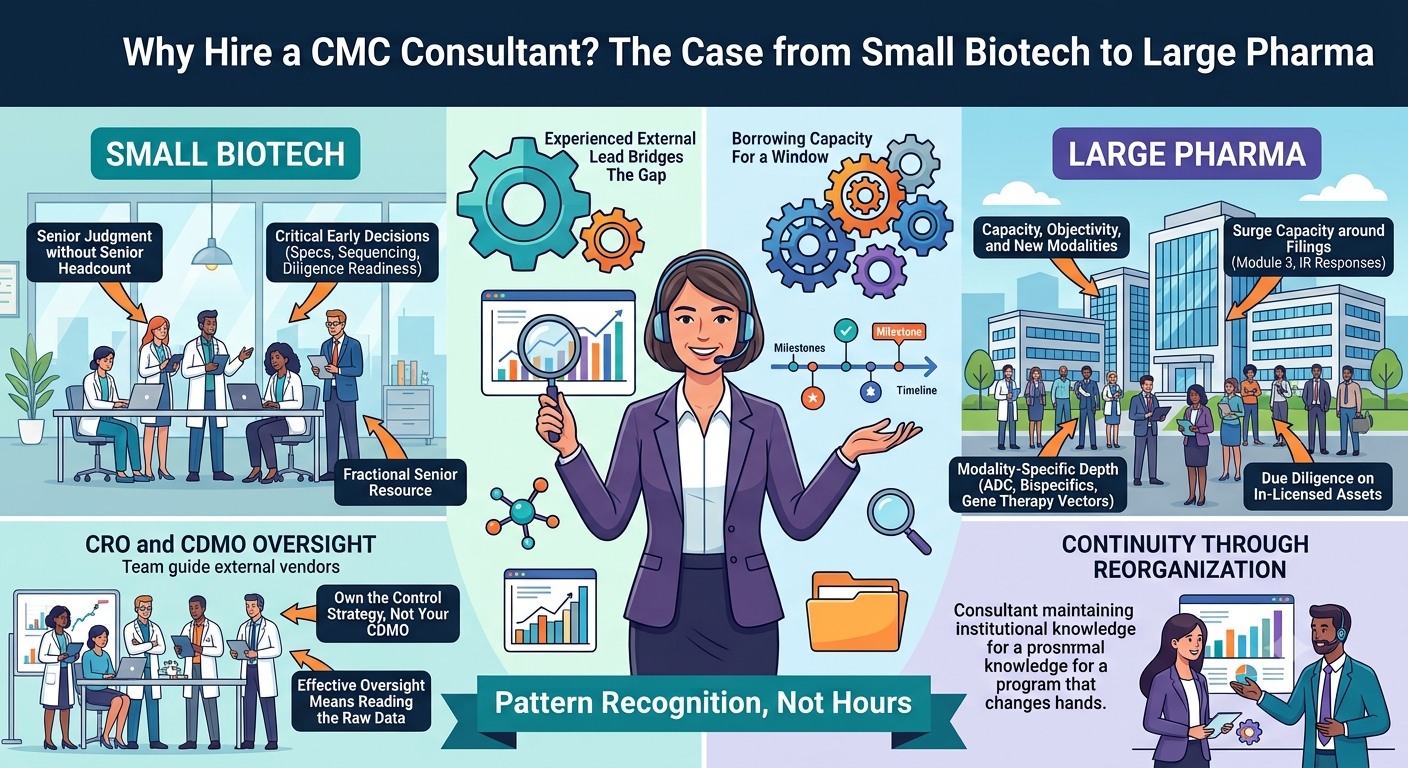
Why Hire a CMC Consultant? The Case from Small Biotech to Large Pharma
CMC is where science meets regulatory reality, and it is the function most likely to be under-resourced in a small biotech and over-committed in a large one. In both cases, an experienced consultant solves a structural problem rather than a staffing gap and the problem is different depending on which end of the spectrum you're on.
The small biotech case: senior judgment without a senior headcount
A twelve-person company with a promising molecule rarely has the budget for a full-time VP of CMC, and often should not have one. What it needs is a handful of decisions made correctly at specific moments, and those decisions have a long half-life.
Specifications set too early are expensive to unset. Provisional acceptance criteria written before understanding your product's variability tend to get locked into an IND and need to be defended for years. Widening a specification after the fact requires justification you may not have generated. Getting the initial ranges right, wide enough to accommodate real manufacturing variability yet tight enough that reviewers see control, is a judgment call built on having watched many programs go through it.
Sequencing is where timelines get delayed. Programs rarely slip because a single assay failed. They slip because method qualification was not started early enough to support GMP release, because the reference standard was not qualified before the lot that needed it, or because two vendors were each waiting on the other. Someone who has run the sequence before can see the potential collisions months in advance and steer the company to avoid them.
Diligence readiness compounds. Partnering conversations and Series B diligence both look hard at the CMC package. A clean, defensible analytical strategy signals operational maturity in a way that preclinical data does not. The inverse is also true. A thin CMC section invites questions about everything else.
The economics are straightforward. A fractional senior resource, engaged on defined deliverables, costs a fraction of the fully loaded expense of a hire you may not need in eighteen months, and starts contributing immediately rather than after a search and a ramp.
CRO and CDMO oversight is where the return is highest
When your manufacturing, analytical development and stability program all live at external sites, your leverage comes entirely from the quality of your technical oversight.
You own the control strategy, not your CDMO. They will execute methods competently and hand you data. They will not decide which attributes are critical for your molecule, how your reference standard program should be structured, or whether the analytical package is coherent across drug substance and drug product. Sponsors who delegate that thinking tend to discover the gap during an information request. That is an expensive place to discover it.
Effective oversight means reading the raw data and not just the summary report, knowing which method transfer acceptance criteria are real and which are decorative, recognizing when an OOS investigation has been closed too neatly, and being able to have a technical conversation with the CDMO's scientists as a peer rather than as a customer. That skill set is hard to hire into a small company and it is what an experienced external lead brings on day one.
The large pharma case: capacity, objectivity, and the modality you have not built yet
Large organizations have deep CMC benches but they still hire consultants.
Surge capacity around filings. Module 3 authoring, comparability packages and information request responses arrive in concentrated bursts. Hiring against a peak that lasts six months is inefficient. Borrowing capacity for exactly that window is not.
Modality-specific depth. A team that has characterized monoclonals for fifteen years is not automatically prepared for an ADC, a bispecific or a gene therapy vector. The analytical questions differ in ways that matter: DAR distribution and free payload for conjugates, chain pairing and mispairing for bispecifics, vector identity and empty to full ratios for AAV. Bringing in someone who has already made the mistakes on that modality is faster than making them internally.
Due diligence on in-licensed assets. Evaluating someone else's CMC package under time pressure is a distinct skill. What was actually qualified versus claimed as qualified, which commitments are embedded in the IND, how much rework the analytical package needs before it can support a BLA. Those are the findings that move valuation and the ones internal teams have the least bandwidth to chase.
Continuity through reorganization. When a program changes hands during a restructuring, institutional knowledge walks out the door. Someone who has been continuously engaged with the technical history is sometimes the only remaining memory of why a decision was made.
You are buying pattern recognition, not hours
The thing that makes CMC expensive to learn is that the lessons are spaced years apart. A scientist inside one company might see two INDs and, if they are lucky and the program survives, one BLA over a decade. That is a small sample from which to build judgment about what a reviewer will question, which comparability exercise will trigger a request for more data, or which specification you will regret setting at Phase 1.
Working across companies compresses that timeline. I have watched the same failure modes show up in molecule after molecule: a sequence variant that was ignored until the BLA, a CQA assessment that was written for the IND and never revisited, comparability plans built after the process change instead of before it. None of these are exotic problems. They are just expensive to discover in late stage.
That is the actual product. Not availability, not bandwidth. Judgment that was paid for by other people's programs.
Independence has practical value
An employee who tells the board that the program is not ready for a pre-BLA meeting is taking a career risk. A consultant saying the same thing is doing the job they were hired to do.
The same applies to due diligence, partnering conversations and internal disagreements about a control strategy. Internal reviewers have relationships to protect and histories with the decisions being examined. An outside technical voice with no stake in the org chart can say that a potency assay is not stability indicating, or that a comparability protocol is unlikely to survive review, without it landing as a critique of a colleague. They can also confirm to a board or an investor that the package is in good shape when it is. Both of those are useful.
When not to hire a consultant
When the work is execution rather than strategy. If you need methods run, hire a contract lab. Consultants are expensive per hour and should be pointed at decisions.
When you cannot act on the advice. A control strategy assessment does not get you much if there is no budget to implement the recommendations. Do the assessment when you can fund the response.
When the scope is genuinely full-time and permanent. If a program will need daily CMC leadership for the next four years, hire someone.
Hire a consultant when the CMC problem in front of you is bigger than the CMC experience inside your company, which for most small biologics companies is most of the time between candidate selection and the BLA. Hire an FTE when the work is continuous, operational and permanent. Many companies need both, and the sequence usually runs consultant first and employee second, with the consultant helping define the role and often helping evaluate the candidates.
Takeaways
Point the engagement at decisions, not at a calendar. The highest value work is concentrated around specific inflection points: CQA and control strategy definition, process change and comparability, method validation strategy, pre-IND and pre-BLA preparation, and diligence.
Bring the outside view in before the decision, not after the deviation. Reviewing a comparability protocol costs a fraction of what it costs to explain a comparability failure.
If your manufacturing and testing are external, treat technical oversight as a function you must own. It is the one thing you cannot outsource to the people you are outsourcing to.
The right question is rarely whether you can afford a consultant. It is what the decision in front of you costs if you get it wrong, and in CMC that is usually measured in months of timeline rather than in fees.
If you are weighing one of those decisions right now, I am happy to talk it through.
New FDA Documents Defining the Path for Cell and Gene Therapy CMC
I have been paying more attention to gene therapy lately, as some of my clients are in that space. Between April and June, the FDA published three documents that significantly impact the CMC and analytical map for cell and gene therapy. The Safety Assessment of Genome Editing using NGS draft guidance came out in April, the Chemistry, Manufacturing, and Controls Flexibilities for CGT BLAs final guidance was issued in May, and Leveraging Prior Knowledge draft for genome editing products followed on June 2. Together, they hint at the regulatory framework sponsors will be operating in for the next decade.
One: CMC Flexibilities for CGT BLAs
The May final guidance, FDA-2026-D-4692, is the most immediately consequential communication of the three because it is effective now. It applies flexibility to CMC expectations across the development arc of any Cell and Gene Therapy (CGT) BLA.
During clinical development, FDA confirms phase-appropriate CGMP and Part 211 exemption for Phase 1 material. Release criteria can be permissive in early phase, but numerical criteria must be predefined before Phase 2 or 3. Comparability for minor manufacturing changes can be supported with limited data when it poses a low risk to product quality.
For process validation, FDA states there is no minimum number of PPQ batches in 21 CFR 601.20 or the CGMP regulations. The number is justified based on product and process understanding. Concurrent release of PPQ batches post-licensure is permitted when PPQ production limitations exist.
For commercial specifications, the guidance acknowledges that small patient populations yield small lot counts at BLA submission. Analytical method validation using a single representative lot may be acceptable with adequate support. Post-approval reevaluation of acceptance criteria can be agreed to in advance via prior approval supplement. Stability data from representative clinical lots can support shelf life, and stability data from similar products may set initial stability periods. Alternative analytical methods, including rapid microbiological methods, can replace compendial methods when validated for the intended use.
Used well, this is a structured set of flexibilities that takes meaningful time and cost out of a BLA package.
Two: Leveraging Prior Knowledge for Gene Therapy Products
The June draft narrows the focus to genome editing and defines what kinds of data can be reused across programs. It distinguishes public knowledge (ICH, USP, EP, peer reviewed literature) from platform knowledge (internal company work, CDMO master files, consortium data).
The most useful concept in the document is the distinction between independent and dependent attributes. Methods, stability infrastructure, and process parameters are typically independent of the specific product, which makes them easier to leverage. Potency, identity, and product specific safety are dependent. Sort your CQA list against this lens first.
Platform analytical methods can be qualified once and applied to similar components, with product specific verification limited to the attributes most affected by differences. gRNAs that differ only in spacer sequence can share lot release specifications. Stability data on one mRNA encoded nuclease can support early phase claims on another. Comparability data for a reagent change on one gRNA can support the same change on a similar gRNA. Platform PPQ data can justify a reduced number of new PPQ batches.
One detail worth knowing: for BLAs, drug substance, intermediate, and drug product information must be in the application itself under 21 CFR 601.2. Master files can be referenced for INDs but cannot substitute for direct inclusion at BLA.
Three: NGS Safety Assessment for Gene Therapy Products
The April guidance sets the standard for the safety call the prior knowledge guidance will not let you transfer. Off-target editing and chromosomal integrity must be evaluated using NGS, with bioinformatics supported by published data or in-house engineering runs, and sequencing depth adequate to detect events below the on target edit rate.
The guidance is explicit on points sponsors have been handling inconsistently. Modality matters: assays for double strand breaks may not pick up base editor nicks. Sample selection matters: ex-vivo studies should use the same cell type at on-target rates comparable to the drug product. In vivo studies should match the clinical delivery method when feasible.
Human genetic variation is now its own analytical question. For diseases with characterized prevalence, in silico off-target assessment should account for population variants from public databases. For ultra rare and single patient indications, this analysis can be deferred with FDA discussion. Chromosomal integrity assessment is recommended for editors creating double strand breaks, with additional assessment for translocations between on target and confirmed off target sites.
All off-target and chromosomal translocation studies should be completed before the original IND, with INTERACT or pre-IND engagement on the strategy.
How They Fit
Taken together these three documents tell sponsors a consistent story. FDA will grant meaningful flexibility on PPQ batches, method validation, commercial specifications, and leverageable platform data. FDA is unlikely to grant flexibility on safety-related issues.
Practical Takeaways
First, build an inventory of leverageable platform data now. The CMC flexibilities and prior knowledge guidances both reward documentation written with leveraging in mind. Map your analytical methods, stability infrastructure, and process knowledge against the independent versus dependent attribute test.
Second, request an INTERACT or pre-IND meeting before committing to a leveraging proposal or an off target assessment strategy of any consequence. All three guidances recommend it.
If you are working in CGT against this new regulatory landscape and want a second set of eyes on your analytical and CMC strategy, I am happy to talk.
Sources:
- FDA Issues Draft Guidance to Help Accelerate Cell and Gene Therapies for Patients (Press Announcement, June 2026) — FDA
- Leveraging Prior Knowledge in the Development of Human Gene Therapy Products Incorporating Genome Editing (Draft Guidance, June 2026, Docket FDA-2026-D-1257) — FDA / CBER
- Chemistry, Manufacturing, and Controls Flexibilities for Developing Human Cellular and Gene Therapy Products for a Biologics License Application (Final Guidance, May 2026, Docket FDA-2026-D-4692) — FDA / CBER
- Safety Assessment of Genome Editing in Human Gene Therapy Products Using Next-Generation Sequencing (Draft Guidance, April 2026) — FDA / CBER
When You Can't Afford the Software Suite and Won't Trust the Free Website
What do you do as a consultant when you need a software tool that either comes bundled in an expensive suite or lives on some random website?
Pasting a proprietary sequence for the next blockbuster drug into an unknown web tool is not something I am comfortable with. And I cannot justify paying more than $10K for a molecular modeling suite I need for one hour. So I decided to build my own tools, with a little help from Claude.
One of the things I genuinely enjoy about consulting is the flexibility to invest time in projects like this. I have always liked programming, but as a manager in big pharma it was mostly a distraction from what I was actually supposed to be doing. Now I have the time, so I used it.
The result is a suite I call Protein Sequence Tools (PS Tools). All four tools operate on amino acid sequences:
Protein Fragment Mass Calculator: Import a sequence, select a portion of it, and calculate the mass of that fragment. Useful when you are working through intact LC-MS data and trying to identify clipping or truncation products. Supports both average and monoisotopic mass.
Protein Digestor: Select an enzyme, get the masses of all proteolytic fragments. There are plenty of these tools online. I wanted one I could trust.
Protein Aligner: Align two or more sequences and highlight the differences. Particularly useful for comparing related antibodies. Includes a choice of algorithms for CDR identification.
Protein Liability Analyzer: Takes a sequence and flags likely liabilities, glycosylation sites, and other PTMs based on rules from the literature. You can also load a PDB file to bring in the crystal structure and factor in solvent accessibility for each potential hot spot.
Yes, I am aware of the irony. I built my own shady website where you paste your protein sequence. The difference is that I know how it was designed and I know it is secure. The tools are written in JavaScript (I also have Python versions), so you can inspect the source directly in your browser or check the GitHub repository.
But you do not have to take my word for it. If you want a version you can run locally and clear with your IT department, reach out. I can provide an executable or an installer package. I charge for my time, but that is all you are paying for. Give the tools a try and let me know what you think.
FDA Rules for AI in Drug Development. What CMC Teams Need to Know
In January 2025, FDA published a draft guidance titled Considerations for the Use of Artificial Intelligence to Support Regulatory Decision-Making for Drug and Biological Products. It covers CDER, CBER, CDRH, and CVM, essentially the full regulatory apparatus. If you work in CMC or analytical development and you haven't read it, you should. Not because it changes everything you're doing right now, but because it draws a line that every team deploying AI needs to understand.
The guidance establishes a risk-based credibility assessment framework for AI models used to produce information or data that supports regulatory decision-making. That's the scope. And the guidance is explicit about what it does not cover: AI used for "operational efficiencies (e.g., internal workflows, resource allocation, drafting/writing a regulatory submission) that do not impact patient safety, drug quality, or the reliability of results."
Drafting a regulatory submission is explicitly out of scope. This is actually good news for the growing number of CMC teams using LLMs to generate first drafts of Quality Overall Summaries, method validation reports, or regulatory justifications. Amgen has published on an LLM-based tool that maps Module 3 content to the appropriate QOS sections and produces a structured first draft in under an hour compared to roughly two weeks by a human writer.
What FDA is asking about is more consequential: the AI models that actually generate the data and conclusions that go into those submissions.
What Falls Under This Guidance
Think about the AI applications that are increasingly common in analytical development and manufacturing:
An AI-based visual inspection system performing 100% automated fill-volume assessment for release testing
A machine learning model predicting shelf-life or stability outcomes from early time-point data
An AI model used to set process parameters or flag out-of-trend results in real-time manufacturing
A predictive model informing specification ranges based on historical characterization data
These applications do impact drug quality and the reliability of regulatory data. They fall squarely within the scope of this guidance. And if you're building or deploying any of them, FDA has now told you exactly how they want you to think about it.
The Framework: Context of Use and Model Risk
The centerpiece of the guidance is a seven-step risk-based credibility assessment framework. The two concepts that will drive most of the practical work are the Context of Use (COU) and model risk.
The COU defines the specific role and scope of the AI model: what question it addresses, what its output is, and whether other evidence will be used alongside it to answer that question. In the guidance's manufacturing example, an AI-based fill-volume inspection tool is used alongside independent release testing of a representative sample. That orthogonal verification reduces the model's influence on the final decision, which in turn lowers model risk. If instead the AI model were the sole determinant of batch release, model risk would be much higher.
Model risk, as FDA defines it, is a function of two factors: model influence (how much the AI's output drives the decision) and decision consequence (how bad it is if that decision is wrong). A model that flags anomalies for human review has lower influence than one making autonomous decisions. A model informing a release decision for a drug with a narrow therapeutic index has higher decision consequence than one used to flag early out-of-trend signals in a development-stage program. The combination determines how much credibility evidence you need and how much FDA scrutiny your AI model will receive.
This is genuinely useful framing. It gives CMC teams a principled way to prioritize and a vocabulary for conversations with FDA.
Life Cycle Maintenance: The Part Everyone Will Underestimate
FDA makes clear that AI model performance can change over time as inputs change. What the guidance calls data drift. In pharmaceutical manufacturing, this means that as your process evolves, your raw material suppliers change, or your equipment ages, an AI model trained on historical data may degrade in ways that are not immediately obvious. FDA expects sponsors to have a plan for monitoring model performance on an ongoing basis and for managing changes through the pharmaceutical quality system.
For teams that have been treating AI models like validated analytical methods (qualify once, use forever) this is a wake-up call. AI models are not static instruments. They are data-dependent systems, and their performance is only valid within the distribution of data they were trained on. Building life cycle maintenance into the deployment plan is not optional if your model is supporting regulatory decisions. FDA is recommending it be included in the marketing application for product- or process-specific AI models.
What This Means Practically Right Now
What hasn't changed: using AI for document drafting, literature review, validation report generation, batch record data extraction and other operational tasks is still fair game and still outside FDA's formal framework. Do it. The efficiency gains are real.
What has changed: if you are deploying AI to generate analytical data or inform manufacturing decisions that go into regulatory submissions, you now have an FDA-endorsed framework for how to document and justify that use. Ignoring that framework is not going to make your submission cleaner, it is going to create questions. Adopting it gives you a structured approach to a conversation that FDA is ready to have.
FDA strongly encourages early engagement when you're uncertain about whether and how this guidance applies. For CDER/CBER biologics programs, CBER's Advanced Technologies Team (CATT) is the right contact for AI in pharmaceutical manufacturing. A pre-IND meeting that addresses your AI deployment plan is far less expensive than a deficiency letter that challenges your data package on credibility grounds.
Four Takeaways for CMC and Analytical Teams
1. Map your AI tools to the COU framework now. For each AI application in your program, ask: What question does it answer? Is it the sole determinant of a regulatory decision, or one input among several? What happens if it's wrong? This exercise will tell you where your credibility documentation gap is.
2. Operational AI tools (QOS drafters, report generators, literature search) are outside this guidance. Deploy them. The regulatory overhead is low and the productivity gains are real — as the Amgen QOS experience demonstrates.
3. For in-scope models, calibrate your documentation effort to your model risk. A low-risk, low-influence model used alongside orthogonal evidence needs less credibility documentation than a model making autonomous release decisions. FDA is not asking for the same package across the board. Match the rigor to the risk.
4. Plan for life cycle maintenance. If your AI model is being deployed in manufacturing or supporting ongoing regulatory decisions, build in performance monitoring, drift detection, and a change management pathway tied to your quality system. Retrofit is much harder than building it in from the start.
If you're thinking through where AI fits in your CMC or analytical development program and how to engage FDA on it, I'd be glad to talk. Reach out here.
Sources:
FDA Draft Guidance: Considerations for the Use of Artificial Intelligence to Support Regulatory Decision-Making for Drug and Biological Products (January 2025) — CDER/CBER/CDRH/CVM/OCE/OCP/OII
Amgen's AI Futures: Digital Twins, Unstructured Data, Human Review — Bio-IT World
The future of regulatory filings: digitalization — AAPS Open
AI for IND & CTA Drafting: Benefits, Risks & Compliance Guide — IntuitionLabs
Mass Spectrometry for ADC Characterization: What You Really Need to Know for IND Filing
Antibody-drug conjugates are among the most analytically complex molecules in the biopharmaceutical pipeline. They sit at the intersection of large-molecule and small-molecule chemistry — and that complexity shows up clearly at the regulatory stage. When teams first approach IND filing for an ADC, one of the most common questions I hear is: "How much MS data do we actually need?"
The honest answer is nuanced. FDA doesn't prescribe a checklist of mass spectrometry experiments for IND. But what they do expect is a scientifically sound understanding of your molecule — and for an ADC, mass spectrometry is the cornerstone of that understanding. Getting this wrong, or doing too little too late, is one of the most common causes of IND hold letters and CMC deficiencies I've seen in practice.
Here's what you need to know.
Why ADCs Are Analytically Unique
A conventional monoclonal antibody is already complex. An ADC is a heterogeneous mixture of conjugates — each molecule carrying a different number of drug payloads (your drug-to-antibody ratio, or DAR), potentially at different conjugation sites, with a linker that introduces its own chemical complexity. On top of that, you have unconjugated antibody, free drug, and aggregated or degraded species to contend with.
This heterogeneity is not a flaw — it's inherent to how most ADCs are made. But it means that standard UV-based or chromatographic methods alone will not give you a complete picture. Mass spectrometry uniquely allows you to resolve and quantify this mixture in ways that no other technique can.
The Core MS Characterization Package for IND
For an IND filing, your MS characterization package should, at minimum, address these questions:
1. What is the average DAR and drug load distribution?
This is typically addressed using hydrophobic interaction chromatography (HIC) coupled with UV detection, but intact mass analysis by native MS or denaturing LC-MS provides orthogonal confirmation and a higher-resolution picture of the distribution. For cysteine-conjugated ADCs, you'll commonly report DAR 0, 2, 4, 6, and 8 species. For site-specific ADCs, the picture is simpler and cleaner — which is one of the analytical advantages of that format.
Average DAR is a critical quality attribute (CQA) that directly impacts both efficacy and safety. FDA will expect you to define it, control it, and monitor it through your release testing.
2. Where is the drug conjugated?
Peptide mapping with LC-MS/MS is your primary tool here. For cysteine conjugation, you're confirming the expected interchain disulfide cysteines are the sites of modification. For lysine conjugation, the picture is more complex and you should be prepared to characterize the distribution of conjugation sites, even if you cannot control to a specific site. For engineered site-specific ADCs, confirming site fidelity is especially important — and is something FDA will look at closely.
At IND, you don't need an exhaustive positional breakdown for every lot, but you do need to demonstrate you understand where the drug is going.
3. What is the intact mass of the conjugate?
Intact mass analysis by LC-MS (electrospray ionization with deconvolution) confirms the overall molecular composition of your ADC. This serves as a high-level identity and purity check — confirming you have the correct heavy and light chain masses, the expected glycosylation profile, and no large-scale unexpected modifications.
For many ADCs, this is done at the intact level and at the subunit level (after IdeS digestion, for example) to allow better mass resolution of the Fc, Fab, and conjugated Fab arms separately.
4. Are there any unexpected modifications or degradation products?
This is where MS earns its keep as a developability and stability tool, not just a characterization tool. Peptide mapping should be designed to detect:
Deamidation and oxidation (standard for any biologic)
Linker hydrolysis or premature drug release
Payload-related modifications (some payloads are reactive under certain conditions)
Succinimide ring opening (particularly relevant for maleimide-linked ADCs)
For IND, your forced degradation and stress study data should be supported by MS to identify the identity of degradation products and confirm whether they are payload-related.
What FDA Is Actually Looking For
FDA's expectations for ADC characterization at IND are laid out across multiple guidance documents — including the 2022 ICH S9 guidance, FDA's own ADC-specific guidance (still evolving), and the broader CMC guidance for biologics. The overarching expectation is **a fit-for-purpose characterization package** that is commensurate with the stage of development.
At IND, this means:
You understand what your molecule is and how it behaves
You've identified your CQAs (DAR, drug load distribution, conjugation site consistency, aggregation, free drug) and have a preliminary justification for why they matter
Your analytical methods are capable of detecting changes in these attributes
Your release and stability specifications are science-based, even if not fully justified yet
What it does not mean is that every MS method needs to be fully validated. Qualification is typically sufficient at IND. Full validation can be deferred to BLA.
Common Mistakes I See
Relying solely on HIC for DAR. HIC is a great method, but it can miss certain conjugate species and doesn't give you direct molecular weight information. A native MS or intact LC-MS experiment to confirm DAR orthogonally is worth the investment.
Undercharacterizing the linker-payload. Teams sometimes focus so heavily on the antibody portion that the linker-payload chemistry gets insufficient attention. The linker stability and its role in PK/PD is increasingly a focus area for FDA reviewers.
No MS on stressed samples. If you haven't looked at your ADC by peptide mapping after temperature stress or oxidative stress, you don't know what's degrading or where. This is exactly the kind of information that shows up as a question in your IND review.
Not tying MS data to CQAs. Data without interpretation is just data. Each MS experiment should be clearly connected to a quality attribute and a clinical/biological rationale for why it matters.
A Practical Starting Point
If you're early in ADC development and building out your IND analytical package, here's a reasonable minimum MS characterization scope:
Intact LC-MS — identity and average DAR confirmation
Subunit LC-MS (post-IdeS or post-reduction) — resolution of conjugated species and glycosylation
Native MS or HIC-MS — drug load distribution and DAR species quantification
Peptide mapping with LC-MS/MS — conjugation site confirmation, sequence coverage, PTM identification
Peptide mapping on stressed samples — degradation pathway identification
This is a starting package, not a complete one. As you move toward Phase 1 and beyond, you'll want to build out your comparability framework, add reference standard characterization, and develop the method lifecycle documentation that supports your BLA.
The Bottom Line
Mass spectrometry is not optional for ADC IND filing — it's foundational. The question isn't whether to include MS data, but whether your MS package tells a coherent scientific story about your molecule. FDA reviewers are increasingly sophisticated about ADC characterization, and gaps in your MS data will surface as questions.
The good news is that with a well-designed characterization strategy, you can build a strong IND package without over-investing at early stage. The key is knowing what questions your MS data needs to answer — and making sure it actually answers them.
The FDA Reforms
It is not every day that I compliment this administration, but mark your calendars, today is such a day. I visited the FDA website and I found it inspiring. I was greeted by a list of their accomplishments featuring 40 bullet points, separated in four categories: Food, Drugs, Public Trust and Modernizing the Agency, and a lot of it makes sense. The full list can be seen here.
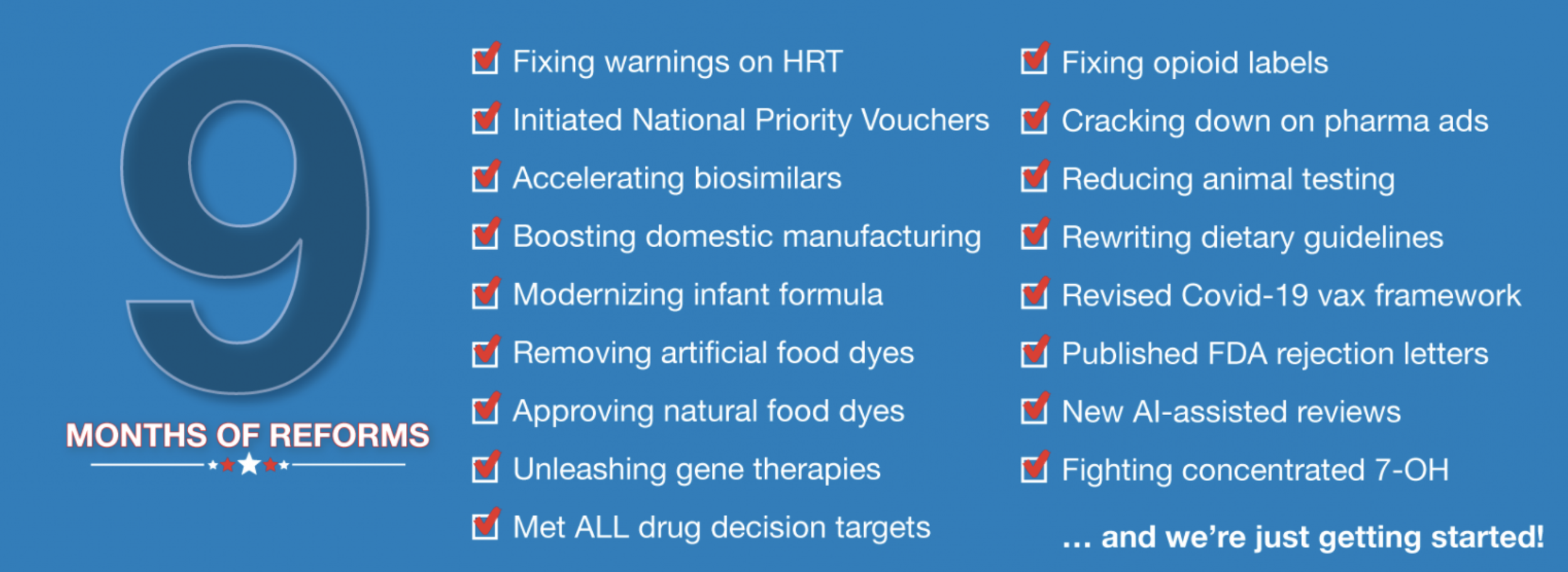
Reform summary at the FDA
I selected a few points that are the most pertinent for the biopharma industry to discuss:
Initiated National Priority Vouchers
The idea is to prioritize products with significant potential to address a major national priority, defined as either 1) meeting a large unmet medical need, 2) reducing downstream health care utilization, 3) addressing a public health crisis, 4) boosting domestic manufacturing, or 5) increasing medication affordability. Those programs will get extra support from the FDA throughout development and are promised an accelerated review, with a response within 1-2 months after filing.
There seem to some overlap with existing prioritization approaches such as Fast Track, Breakthrough Therapy, Accelerated Approval and Priority Review, but if that brings more medicines to market quicker, I am all for it. I also like the idea of prioritizing medicines that will be manufactured un the US, as it could create more jobs in pharma.
Cut Red Tape to Accelerate Biosimilars
The FDA's new guidance seeks to remove the requirement for biosimilars developers to conduct comparative human clinical studies, allowing them to rely instead on analytical testing to demonstrate product similarity.
Furthermore, switching studies, where sponsors alternate between originator and biosimilar (to claim interchangeability) will not be generally recommended. This is could significantly lower the price of biosimilars.
Stopping Unnecessary Animal Testing
The agency wants to reduce or replace animal testing requirements with a range of approaches, including AI-based computational models, cell lines and organoid toxicity testing. This means using lab-grown human “organoids” and organ-on-a-chip to test drug safety. These experiments can reveal toxic effects that could easily go undetected in animals, providing a more direct window into human responses.
The roadmap also encourages sponsors to leverage computer modeling and artificial intelligence to predict a drug’s behavior.
Boosting Domestic Pharmaceutical Manufacturing
The FDA PreCheck program was developed to promote domestic production of critical medicines by streamlining the review of those that will be produced in the USA. This program should improve regulatory predictability and shorten time-to-market.
The FDA will support the sponsors with more frequent communications at critical development stages and help them streamline the development and license application process through pre-application meetings and early feedback. This should have a positive impact in job creation in the pharma industry.
Unleashing Cutting-Edge Gene Therapies
FDA has leveraged its growing experience with Cell and Gene Therapy (CGT) products to implement regulatory flexibilities that accommodate the unique characteristics of these innovative therapies while maintaining rigorous quality standards.
This approach allows regulatory flexibility during clinical development, including relaxed compliance with full GMP requirements prior to late-phase trials, while encouraging ongoing engagement with reviewers as CGT manufacturing continue to rapidly evolve.
Cracking Down on Misleading Pharma Ads
This initiative will enforce a format for cable TV and online ads that will be more balanced and clearly highlights the downsides of the medications as well as the benefits. This will encourage companies to spend less on marketing and create more affordability. Coming from a different country, I must say that the drug commercials are ridiculous here. It plays into the anxiety of vulnerable segments of the population and encourages widespread drug overconsumption. This will not completely stop direct-to-consumer advertising, but any step in that direction is welcome.
Launched Internal AI Tool to Help FDA Employees Work More Efficiently
The tool is called Elsa and lives on a secure cloud-based environment engineered for safety and privacy. It is currently in use to assist reading, writing and summarizing documents to enable faster comparisons. The agency plans to integrate more AI in different processes to further support the FDA’s mission.
They claim to have successfully completed the first AI-assisted scientific review pilot in May 2025 albeit sparce details have been shared. The generative AI tool allow FDA scientists and subject-matter experts to spend less time on tedious, repetitive tasks that often slow down the review process. Everybody uses AI, so it makes sense for the FDA regulators to use it too. It is an interesting to follow as the sponsors and regulator increase their reliance on AI for regulatory submissions and approvals.
What Smart Pharma Companies Should do in 2026
Design programs for what FDA is becoming, not the one you are used to. FDA is explicitly signaling trust in analytics, AI, and human-relevant models over default animal studies and redundant clinical trials. Companies that re-architect development around this reality will move faster and cheaper.
Align portfolios with national priorities Priority vouchers and domestic manufacturing incentives make it clear: regulatory speed is now tied to unmet need, affordability, public health impact, and U.S. manufacturing resilience. Strategic alignment is becoming as important as scientific merit.
Treat CMC as a strategic weapon. FDA’s flexibility for cell and gene therapies lowers early barriers but raises the bar later. The winners will be companies that invest early in process understanding, comparability, and manufacturing agility - long before regulators are forced to ask.
CQA Assessment Using ChatGPT
Recently I had the chance to play with ChatGPT to perform CQA risk assessment. It is something I attempted to do a few months ago when I was at a company. We could only use the most basic version of Copilot and the results were not entirely satisfactory. This time I used ChatGPT+ and the sequence for trastuzumab as an example. The results are scarily good. Notice it finds that W35 is not part of the CDR according to Kabat notation, but knows that it is adjacent to it and therefore oxidation of that residue could still disrupt binding.
Note that I did not ask to provide the literature references to this example, but one can easily add this to the prompt and ChatGPT will oblige. I tried several other modifications and was frustratingly surprised by the answers. Finally, I am not claiming that ChatGPT is better than Copilot for that type of work, just highlighting how fast the field has progressed in just a few months.
Prompt:
This monoclonal antibody (IgG1) is formed of 2 identical light chains and two identical heavy chains as follows:
>Anti-HER2 Light chain (1 and 2)
DIQMTQSPSSLSASVGDRVTITCRASQDVNTAVAWYQQKPGKAPKLLIYSASFLYSGVPS
RFSGSRSGTDFTLTISSLQPEDFATYYCQQHYTTPPTFGQGTKVEIKRTVAAPSVFIFPP
SDEQLKSGTASVVCLLNNFYPREAKVQWKVDNALQSGNSQESVTEQDSKDSTYSLSSTLT
LSKADYEKHKVYACEVTHQGLSSPVTKSFNRGEC

>Anti-HER2 Heavy chain (1 and 2)
EVQLVESGGGLVQPGGSLRLSCAASGFNIKDTYIHWVRQAPGKGLEWVARIYPTNGYTRY
ADSVKGRFTISADTSKNTAYLQMNSLRAEDTAVYYCSRWGGDGFYAMDYWGQGTLVTVSS
ASTKGPSVFPLAPSSKSTSGGTAALGCLVKDYFPEPVTVSWNSGALTSGVHTFPAVLQSS
GLYSLSSVVTVPSSSLGTQTYICNVNHKPSNTKVDKKVEPKSCDKTHTCPPCPAPELLGG
PSVFLFPPKPKDTLMISRTPEVTCVVVDVSHEDPEVKFNWYVDGVEVHNAKTKPREEQYN
STYRVVSVLTVLHQDWLNGKEYKCKVSNKALPAPIEKTISKAKGQPREPQVYTLPPSREE
MTKNQVSLTCLVKGFYPSDIAVEWESNGQPENNYKTTPPVLDSDGSFFLYSKLTVDKSRW
QQGNVFSCSVMHEALHNHYTQKSLSLSPGK
Summarize the risks of W35 oxidation with respect to the 4 following risk categories: biological activity, PK/PD, immunogenicity and safety.
Short answer:
For this IgG1, isolated oxidation of heavy-chain W35 (Kabat, in VH framework 2, “DTYIHWV…”) is generally a low-to-moderate risk liability. Main concern is local Fab destabilization and possible impact on antigen affinity; Fc-mediated PK and classic safety signals are much less directly affected.
Long answer:
1. Biological activity (target binding, effector function)
Location / role
W35 is in the VH framework 2, adjacent to CDR-H1/2, not in Fc.
It contributes to the hydrophobic core that positions the CDR loops and the VH–VL interface rather than directly contacting HER2.
Effect of oxidation
Tryptophan oxidation → hydroxy-Trp, N-formylkynurenine, kynurenine:
Increases polarity in a mostly hydrophobic environment.
Can slightly destabilize the VH framework and alter CDR geometry.
At low levels (a few percent of molecules oxidized at W35):
Expected effect on HER2 binding affinity is typically small.
ADCC/CDC are largely unchanged if antigen binding and Fc remain intact.
At high levels or if oxidation correlates with partial unfolding:
Could reduce affinity and cell-based potency by mis-positioning CDR-H1/H2 or VH–VL.
Risk assessment for biological activity
Intrinsic risk: Low to moderate.
More likely to produce a gradual potency drift than a binary loss of function.
Risk is best quantified by forced-oxidation + binding / cell-based potency comparison and setting a control limit on oxidized variants if needed.
2. PK/PD
Direct mechanisms
W35 is in the Fab variable domain, not in CH2/CH3 where:
FcRn binding sites reside.
Classical Fc oxidation hot spots (e.g., M252/M428, W313) live.
Direct effects on FcRn-mediated recycling, nonspecific Fc receptor interactions, or charge-based clearance are expected to be minimal.
Indirect mechanisms
If W35 oxidation significantly destabilizes the Fab, possible consequences:
Slightly increased fragmentation or aggregation.
Enhanced clearance of aggregates or partially unfolded species.
At realistic in-product levels (e.g., ≤5–10% oxidized at that site), these effects on systemic PK are usually smalland may be within normal batch-to-batch variability.
Risk assessment for PK/PD
Direct PK risk: Low.
Indirect PK/PD risk via instability/aggregation: Low to at most moderate, contingent on empirical data.
Focus PK risk control more on Fc and high-level aggregation than on this single Fab Trp site.
3. Immunogenicity
Potential immunogenic mechanisms
Neo-epitope formation
Oxidized Trp can slightly change local conformation and side-chain chemistry.
The region is in VH framework 2, partly solvent-exposed.
This can, in principle, alter MHC-II peptide repertoire and T-cell recognition.
However, clinical evidence that single-site Trp oxidation in Fab alone drives ADA is limited.
Aggregation-driven immunogenicity
If W35 oxidation destabilizes VH and increases:
Reversible or irreversible aggregates
Subvisible particles
These species are more relevant immunogenicity drivers than the chemical modification itself.
Risk assessment for immunogenicity
Intrinsic chemical neo-epitope risk at W35: Theoretical but low at typical levels.
Aggregation-mediated immunogenicity:
Depends on whether W35 oxidation correlates with increased aggregates under real storage conditions.
Usually managed by controlling total aggregates and oxidized variants.
Overall: Low immunogenicity risk, provided:
W35 oxidation is kept in a controlled range.
Aggregates and subvisible particles remain within standard limits.
Clinical ADA monitoring does not show a correlation with high-oxidation lots.
4. Safety (including off-target effects)
Direct safety concerns
W35 is not in Fc; no direct link to:
Complement overactivation.
FcγR hyper-engagement.
Oxidation at this site is unlikely to introduce a strong new off-target receptor interaction.
Indirect safety concerns
Same mechanisms as immunogenicity:
More aggregates or fragments → potential for infusion reactions or ADA-mediated effects.
Loss of binding specificity (if Fab is destabilized) could, in extreme cases, slightly increase nonspecific binding, but this typically appears only under harsh stress and very high oxidation.
Risk assessment for safety
Direct safety risk: Very low.
Indirect safety risk:
Tied to aggregation and immunogenicity.
Expected to be low if product-quality attributes (oxidation levels, aggregates, particles) meet standard biologics limits and no unusual clinical signals are seen.
Practical takeaways
W35 oxidation is a secondary Fab liability, not a primary one like Fc Met oxidation.
Key control strategy:
Characterize W35 oxidation in forced-degradation and long-term stability.
Correlate with:
HER2 binding / cell-based potency.
Aggregate and fragment levels.
Any ADA or safety signals, if clinical data exist.
If no strong correlations emerge, W35 oxidation can typically be treated as a monitored but not critical quality attribute with relatively broad acceptance limits compared with Fc oxidation hot spots.
First Post
It all begins with an idea.
I am a consultant now. This is something I knew I wanted to try at some point in my career, so here it is. I am consulting on topics related to analytical development of biologics and I intend to post reflections on our industry, as well as practical tips and strategies to shorten development timelines and use less resources.
I wanted to have a central repository for my work-related writings. Some of it will probably end up being cross-posted to other places, but I wanted to have this source repository for myself. Expect topics about analytical strategy, CMC, outsourcing, consulting and AI to be published once a month.
I am particularly interested in exploring how AI and data science can make certain aspects of our work irrelevant or whole functions redundant.